



The 1% Shift: 5 Surprising Realities of the 2026 Colorado Housing Market
1. Introduction: The Modern Homebuyer's Dilemma
In the volatile wake of the early 2020s, the U.S. real estate market has been a landscape defined by "wait-and-see" fatigue. However, as of March 2026, the narrative has shifted fundamentally. Mortgage rates have finally breached the "psychological barrier" of 6%, with the average 30-year fixed rate settling at 5.87% as of March 3.
To the casual observer, a 1% interest rate movement is a technical footnote. To the analyst, it is a total rewrite of the buyer’s financial story. In this new climate, understanding the relationship between the "monthly weight" of a loan and actual purchasing power is no longer optional—it is the only way to navigate a market that is finally showing signs of a hard-won equilibrium.
2. The 1/10 Rule: Why Falling Rates Just Reclaimed Your Buying Power
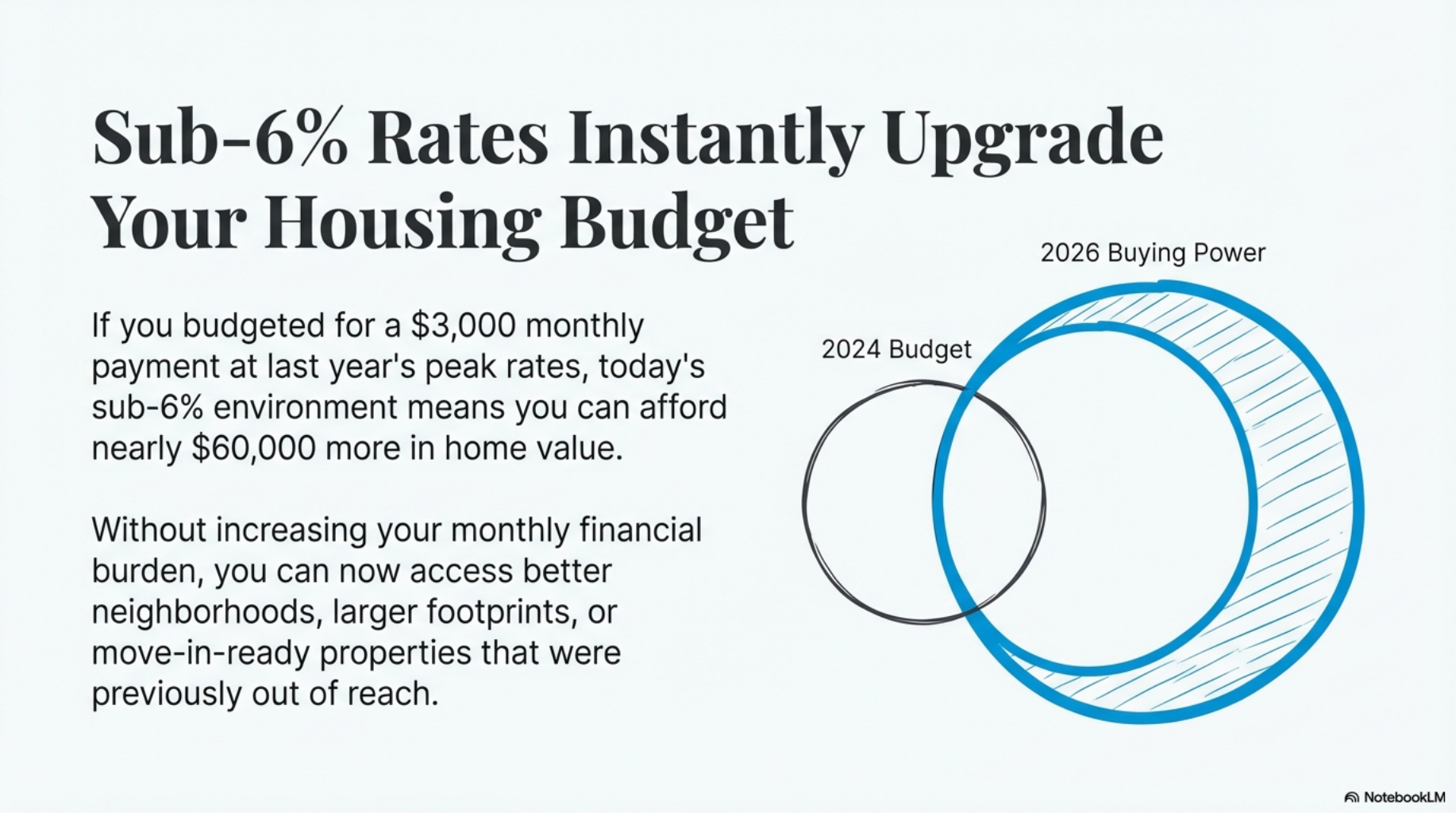 Surprising Reality: A mere 1% drop in interest rates has effectively handed 2026 buyers a 10% "raise" in their home-shopping budget.
Veteran Real Estate Broker Karen Schlosser utilizes the "1/10 Rule" to demystify affordability: for every 1% movement in interest rates, a buyer’s purchasing power shifts by 10% in the opposite direction.
- The Math: If you qualified for a $250,000 mortgage when rates were higher, a 1% dip increases your power to $275,000. Conversely, if you were looking at a $250,000 mortgage and rates rose 1%, your purchasing power would drop 10% to 225,000(250,000 minus $25,000).
- The 2026 Context: If we look back at the 7% rates that plagued 2023, the current sub-6% environment means buyers have regained approximately 10% of their purchasing power.
Schlosser, who purchased her first home in 1980 when rates hit a staggering 14%, emphasizes that successful buying is about "monthly weight" rather than sticker price:
“If you said [14%] to most people today, they would say, 'That will slam the brakes on the housing market.' The reality is it didn't stop me from buying a home. It just adjusted my purchasing budget. People will continue to buy homes. It's just a matter of budgeting for that.”
3. Beyond the Headlines: The Affordability Paradox in Denver
Surprising Reality: Affordability in the Metro Denver region has improved by double digits (12.9%) even though active inventory has continued to tighten.
The January 2026 data presents a fascinating "Analyst’s Paradox." While prices are softening in the Single-Family segment, the market remains technically tipped toward sellers.
Metro Denver Single-Family Market Snapshot (Jan 2026 vs. Jan 2025):
- Median Sales Price: $589,000 (a 3.3% decrease)
- Average Sales Price: $695,103 (a 4.0% decrease)
- Housing Affordability Index: Increased to 79 (a 12.9% improvement)
- Days on Market (DOM): 77 days (up 18.5%)
- Inventory of Active Listings: Dropped 11.5% to 7,977 units.
While Single-Family prices fell, the Townhouse-Condo segment saw its Average Sales Price increase 1.4% to $468,037. From a policy perspective, the 11.4% spike in "Pending/Under Contract" listings is a vital leading indicator of resurgent buyer demand. Furthermore, while the increase in DOM to 77 days offers a breather for due diligence, the 2.4-month supply of inventory confirms we are still in a seller's market (as a "balanced market" requires 4–7 months of supply).
For buyers in the San Luis Valley and Alamosa, these metro trends serve as a bellwether. Watch for increasing DOM and slowing price growth in your local listings; these are the primary indicators of increased negotiation power.
4. Strategies for the Sub-6% Era
As of March 3, 2026, 15-year mortgage rates are averaging 5.37%. To capitalize on this "window of affordability," buyers must pivot from the survival strategies of 2023 to the precision strategies of 2026:
- Lending Term Pivot: Explore the 15-year rate (5.37%) or Adjustable Rate Mortgages (ARMs) to maximize early equity growth.
- The 20% Buffer: If possible, move from a 15% to a 20% down payment. This doesn't just lower the monthly weight; it often allows you to negotiate a lower interest rate with the lender.
- Credit Mix Audit: Lenders are looking at payment history and credit mix with increased scrutiny in 2026. Focus on clearing balances rather than opening new lines.
- Financial Fitness: Avoid any large purchases or job changes during the loan process to prevent "red flags" during the final verification.
- Execution Speed: To prevent changing market conditions from derailing a loan, ask the lender to order the appraisal the day the offer is accepted. Expedited appraisals are the hallmark of a savvy 2026 transaction.
5. Conclusion: The Final Lesson in Flexibility
The "perfect" home in 2026 is a product of timing and clinical financial planning. As we move through a sub-6% March, the question for every prospective buyer is no longer "When will rates drop?" but rather, "Is my budget ready for the doors that have finally opened?"
Are you prioritizing a "dream home" or a "dream budget"? Planning for the "monthly weight" today ensures you can carry that dream for decades. For those in the San Luis Valley, connect with your local REALTOR® network to see how these statewide indicators of affordability are manifesting in the Alamosa area. The shift has happened—your strategy must follow.
The Most Important Commitment in Real Estate: Why You Need a Fiduciary in Your Corner